
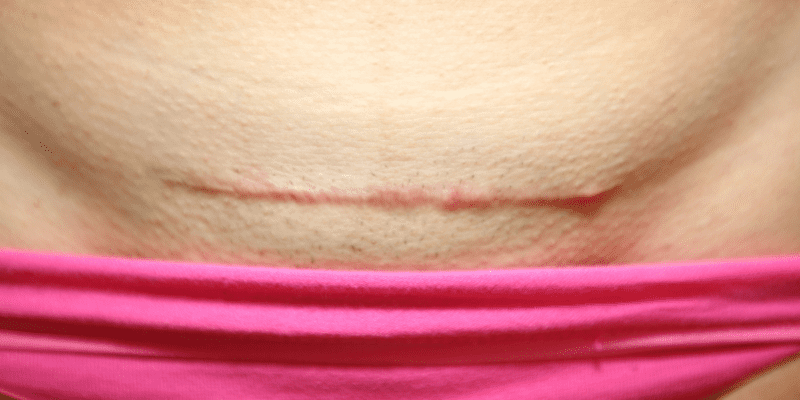
No one told me that a caesarean birth could change my body for life.
I was told how the surgery would happen. I was told how long recovery might take. I was told when I could drive again, lift a kettle, or return to daily life. What I was not told was that years later, I might live with chronic pelvic pain, that smear tests could become intolerable, or that penetrative sex might no longer be possible.
This is my story – and it is far from unique.
Caesarean birth rates are at an all-time high in the UK. In many areas, more babies are now born via caesarean section than vaginally. Yet despite how common this surgery has become, there is a profound and troubling silence around the long-term impact it can have on women’s bodies, relationships, and quality of life.
I’ve had three caesarean sections. The first was an emergency. The second and third were elective, following advice from a consultant gynaecologist that this was the lower-risk option for me. My third and final caesarean was over twenty years ago.
I experienced post-operative infection. Years later, I required further surgery to remove endometrial tissue from my abdominal cavity – tissue that was likely left behind during one of my caesareans. And for over a decade, I’ve lived with intense, searing pain high around my cervix, so severe that smear tests and penetrative sex are intolerable. We stopped trying years ago.
What is perhaps hardest to name is this: I have only recently discovered that this pain could be linked to internal scar tissue and adhesions caused by multiple abdominal surgeries. For years, I wondered whether the pain was “in my head”. Whether I was imagining it. Whether it was somehow connected to childhood sexual trauma I had worked hard to heal from.
I questioned myself far more than I ever questioned the medical system.
Not once – not from a nurse, not from a pelvic health physiotherapist, not from a consultant gynaecologist – did anyone explain that adhesions following multiple caesarean sections could cause exactly this type of pain. This was despite me disclosing the problem, clinicians witnessing my extreme pain during internal examinations, and years of appointments where my distress was visible. That silence did damage.
I am lucky. I have an understanding, patient husband. Many women are not. How many relationships quietly fracture under the weight of unspoken pain, guilt, confusion, and loss? And why are we still not talking about this?
A caesarean section is major abdominal surgery, not simply “another way to give birth”. It cuts through skin, fascia (connective tissue), abdominal muscles, nerves, blood vessels, and the uterus itself. The body does not heal by returning everything to how it was before. It heals by laying down scar tissue, both externally and internally. Internal scar tissue, known as adhesions, can bind organs together, restrict movement, and irritate or entrap nerves.
This is not rare. It’s not a failure to heal properly. This is a known biological consequence of abdominal surgery. Yet many women are sent home with little more than advice not to lift anything heavy. Adhesions can form between the uterus, bladder, bowel, abdominal wall, and pelvic structures. They rarely show up on scans, can worsen over time, and can cause pain many years or even decades after surgery. With multiple caesareans, adhesions are more likely to be dense, widespread, and complex, increasing the risk of chronic pelvic pain.
During surgery, nerves can also be cut, stretched, or later trapped within scar tissue. This can lead to pain often described as burning, searing, electric or disproportionate to touch or pressure. Pain high around the cervix, particularly pain triggered by smear tests or penetrative sex, is strongly suggestive of nerve involvement or tethering of pelvic structures.
Caesarean birth can also cause or worsen endometriosis. Endometrial tissue can be transferred into the abdominal cavity during surgery – known as iatrogenic, or surgery-induced, endometriosis. This tissue may implant in the abdominal wall, the pelvis, or around the cervix and uterosacral ligaments.
This is not theoretical. I have lived this reality. Scar tissue can also alter pelvic anatomy, pulling the uterus forward or restricting the natural movement of the cervix. When pressure is applied during sex or cervical screening, the pain can be excruciating. Too often, women are told everything is “normal” because imaging looks fine. Normal scans do not equal a normal lived experience.
So why, when caesarean rates are so high, are women not routinely told that internal scar tissue is likely? That pain may emerge years later? That sex may become painful or impossible? That smear tests may be intolerable? That specialist scar care exists but is rarely offered?
Why are women not routinely offered pelvic health physiotherapy, post-surgical scar education, or long-term follow-up?
We would never treat other forms of major surgery this way.
Why do we accept it for women?
We talk about postnatal sex in vague terms – “when you’re ready”, “give it time”. What we don’t talk about is that some women will never tolerate penetration again without specialist care, that some live with daily pelvic pain they feel unable to name, and that some couples quietly grieve a sex life that disappeared without explanation.
Pain is not a relationship failure, it’s a healthcare failure. This is not about blaming caesareans. Caesareans save lives. Mine included.
This is about informed consent, aftercare, and respect for women’s bodies long after the baby is born.
If caesareans are now one of the most common forms of birth, then long-term, trauma-informed aftercare must be part of the package – not an optional extra.
I am speaking now because suffering quietly helps no one. Because women are lying awake at night wondering what is wrong with them. Because pain shared becomes knowledge – and knowledge is how systems change.
If this story sounds familiar to you, please know this: you are not broken, you are not weak, and you are not imagining it.
In conclusion, caesarean birth saves lives, and for many women it is essential. But saving a life should not come at the cost of decades of unmanaged pain and silence. If caesareans are now the most common form of birth, then long-term, trauma-informed aftercare must be part of the conversation – not an afterthought.
Women deserve better than coping alone. I’m done staying quiet.
References and further reading
NHS – Caesarean section overview and recovery
The NHS acknowledges caesarean birth as major surgery but focuses primarily on short-term recovery. There is minimal guidance on long-term pelvic pain, adhesions, or sexual pain following caesarean delivery.
National Institute for Health and Care Excellence (NICE) – Caesarean birth guideline NG192
NICE guidelines outline indications and immediate risks of caesarean birth but contain limited discussion of long-term complications such as adhesions, chronic pelvic pain, or sexual dysfunction.
Tulandi T et al. – Adhesion formation and reproductive surgery (Fertility and Sterility)
This paper documents the high prevalence of adhesions following abdominal and pelvic surgery and their association with chronic pain, infertility, and bowel and bladder dysfunction.
Morales KJ et al. – Pelvic adhesions after multiple caesarean deliveries (American Journal of Obstetrics and Gynecology)
Evidence showing that the risk, density, and complexity of adhesions increase significantly with each additional caesarean section.
Horton JD et al. – Abdominal wall endometriosis: a surgeon’s perspective (American Journal of Surgery)
Explores how endometrial tissue can be transferred during caesarean surgery, leading to chronic pain years later.
Yong PJ et al. – Chronic pelvic pain and central sensitisation (Best Practice & Research Clinical Obstetrics & Gynaecology)
Highlights how unresolved surgical pain and delayed diagnosis can contribute to long-term nervous system sensitisation.
International Pelvic Pain Society – Pelvic pain after gynaecological surgery
Provides education on post-surgical pelvic pain, nerve involvement, and the limitations of imaging in diagnosing adhesions.