If you’ve ever typed “why does my whole body hurt?” into Google, this post is for you.
Aching joints. Muscles that feel bruised for no reason. A tiredness that sleep doesn’t fix.
And a quiet voice telling you it’s probably just menopause, or just getting older, or just you.
I recently found out there was a reason behind a lot of mine.
In September 2026, a consultant rheumatologist diagnosed me with Hypermobility Spectrum Disorder (HSD). I’m in my fifties. I’ve been a personal trainer and a yoga teacher. And for most of my life, I had no idea.
Since then, I’ve been looking back over my whole life. Things that never made sense have started to line up. And I have rather a lot of feelings about that.
Is it just menopause? Not always
Falling oestrogen can absolutely cause joint aches, stiffness and fatigue in midlife.
But not always. Or not only.
Menopause can unmask something that has been there all along, quietly held together by your hormones, your fitness and your sheer determination.
That’s what happened to me. If your symptoms feel bigger than “just menopause”, or HRT hasn’t touched them, it’s worth asking whether something else is going on.
What is Hypermobility Spectrum Disorder (HSD)?
Hypermobility means some of your joints move further than usual. For some people, that’s harmless. Lots of dancers, gymnasts and yoga lovers are hypermobile and never have a problem.
For others, it comes with pain, fatigue and a whole range of other symptoms that affect everyday life. That’s when it may be Hypermobility Spectrum Disorder (HSD) or hypermobile Ehlers-Danlos syndrome (hEDS).
Both are connective tissue conditions. Connective tissue, including collagen, is the body’s scaffolding. It holds joints together, supports organs and gives skin and blood vessels their structure. When it’s more stretchy than it should be, the effects can show up almost anywhere in the body.
That’s why HSD is about far more than being “bendy”.
Doctors often use the Beighton score in the assessment. It’s a simple test of things like whether your thumb bends back to your forearm, your little fingers bend back past 90 degrees, your elbows and knees extend beyond straight, and whether you can put your palms flat on the floor. I scored 5 out of 9. My thumbs touch my forearms, my fingers hyperextend, and my knees, elbows and feet are hypermobile too.
But the score is only part of the picture. A diagnosis also looks at your symptoms, your history and your family. Hypermobility often runs in families, and it does in mine.
Why does my whole body hurt? Hypermobility and widespread joint and muscle pain
This was the question I kept coming back to.
My pain isn’t in one place. It moves around. Over the last year, it has looked like this:
-
- Sharp, achy pain in my wrists and elbows whenever I lift anything with weight
-
- Hip pain when I move, especially on the right, and after walking for more than about 40 minutes, which then lasts for days
-
- A right shoulder that feels fragile, clicks constantly and hurts
-
- Waking at night with pain in my hip, shoulder and back
-
- Ankles that have given way and caused injuries over the years
So why does hypermobility cause pain all over?
When your ligaments and connective tissue are looser, your joints have less natural stability. Your muscles have to step in and do that job instead. All day, every day.
Muscles that are constantly working to hold you together get tired, tight and sore. Joints that move beyond their comfortable range pick up lots of small strains. Over years, that adds up.
I’ve probably spent a lifetime overextending my joints without realising it.
There’s another layer too. When the body is in pain for a long time, the nervous system can become more sensitive, so pain signals get turned up. That’s not “all in your head”. It’s a real, physical change in how pain is processed.
Some things help me and some really don’t. Heat and gentle movement ease my symptoms. Massage has actually made them worse, and I couldn’t tolerate acupuncture. If treatments that help other people seem to leave you feeling worse, that may be worth mentioning to your GP too.
Why am I so tired? Hypermobility and fatigue
The exhaustion has been one of the hardest parts.
I’m not talking about feeling a bit sleepy. I mean needing to sleep during the day.
Fatigue is very common with HSD, and there are usually several reasons layered on top of each other:
-
- Your muscles are working overtime. Holding unstable joints in place uses a lot of energy, even when you’re sitting still.
-
- Pain disrupts sleep. Waking in pain means you never get the deep rest your body needs.
-
- Your nervous system may be affected. Many hypermobile people also experience dizziness when standing up, a racing heart or palpitations. These are linked to the autonomic nervous system, which controls things like blood pressure and heart rate. I’ve had dizziness on standing for a few years, and it’s been worse this year.
-
- Recovery takes longer. Tissues that are under constant strain don’t bounce back as quickly.
My consultant described my fatigue as “likely multifactorial”, meaning lots of things feeding into it. He also ordered blood tests to rule out other causes, like low iron or B12, or an autoimmune condition.
So if you’re exhausted, please ask your GP to check the basics too.
When my workouts became impossible
Exercise has been part of my life and my work for a long time. But if I’m honest, my workouts were always a challenge for me.
I’ve always listened to my body. But I’ve also always liked to push myself. To go a little further. To go a little heavier.
Looking back, I think that may have caused more harm than good in the long run.
After menopause, things started to change.
Each workout brought more pain and more exhaustion, and I found myself adapting more and more of every session to avoid aggravating my hips, back and shoulders.
Eventually, I simply couldn’t finish my workouts.
I needed days to recover. And I couldn’t even pick up a weight without my finger, wrist, elbow and shoulder joints screaming at me.
In the end, I cancelled my gym membership. For someone who has spent years helping other women get stronger, that was a big moment.
Why menopause can make hypermobility worse
Oestrogen plays a part in how our connective tissue and collagen behave. As levels fall during perimenopause and menopause, many hypermobile women notice their symptoms getting worse.
The Hypermobility Syndromes Association describes how hormonal changes and hypermobility together “can amplify the severity of the symptoms”. They also note that much more research is needed.
My own experience fits this. I went through menopause in my late forties and took HRT for five years. I felt it gave me some relief from joint pain and stiffness.
I came off HRT in February 2025. At first I felt fine. But over this year, things have got significantly worse.
I can’t say for certain how much is hormones and how much is HSD. They overlap, which is exactly why one can hide behind the other.
Hypermobility and ADHD: the link not everyone knows about
I have ADHD, and I work as an ADHD and neurodiversity coach. My consultant listed my neurodivergence as one of the features supporting my HSD diagnosis.
Research from the University of Sussex and Brighton and Sussex Medical School found that more than half of neurodivergent people in their study (including people with ADHD and autism) had joint hypermobility, compared with around one in five of the general population. Neurodivergent people were also more likely to experience pain and symptoms like dizziness on standing.
Other studies, including one from Sweden looking specifically at adults with ADHD, have found a similar link.
Researchers are still working out why. It may be that the same genes and connective tissue differences influence both the body and the brain.
If you have ADHD and you live with unexplained pain, fatigue or dizziness, hypermobility is worth asking about. And if you’re hypermobile and have always felt your brain works a little differently, that may be worth exploring too.
The lightbulb moments I missed for decades
Lightbulb moment 1: Local anaesthetic that didn’t work
At the dentist, I needed around three times the usual amount to get numb.
During labour, my epidural top-ups barely touched the sides. The nurses were surprised I could still feel the ice cube they used to test my reaction. It took a lot to go numb.
There is research suggesting local anaesthetics can be less effective in some people with hypermobility conditions. I wish I’d known that then. My consultant has now advised me to tell my dentist about my diagnosis.
Lightbulb moment 2: Pain that was never really explained
Painful smear tests. Vaginal pain. A pelvic floor that has likely been hypertonic.
Hypertonic means overactive or too tight. The muscles hold on and struggle to fully relax, which can cause pain. It’s easy to assume a hypermobile body would have a weak pelvic floor, but it isn’t always that simple. One theory is that when connective tissue is lax, muscles tighten up to compensate and stay “switched on” to protect you.
Each one of these was treated as a separate problem, or as something to put up with.
Lightbulb moment 3: All the “unrelated” little things
Some of the things my consultant noted had never seemed connected to anything:
-
- Raynaud’s, where my fingers go white in the cold, now affecting my feet too
-
- Chilblains on my feet for the first time in my life
-
- Small bumps on my heels when I stand, called piezogenic papules
-
- Scars that heal thick or wide
-
- Yoga teachers commenting on how far my elbows went
On their own, each seemed like nothing. Together, they told a story.
Lightbulb moment 4: When my own advice stopped working
As a personal trainer, I’ve said it many times. “Lift heavy for your bones.” “Use it or lose it” to protect against age-related muscle loss.
It’s sound advice for many people. But my body doesn’t respond the way those rules assume, and I’m now fearful of exercise in a way I never used to be.
I’m only just beginning to learn what safe strength looks like for a hypermobile body.
Lightbulb moment 5: Yoga isn’t my friend
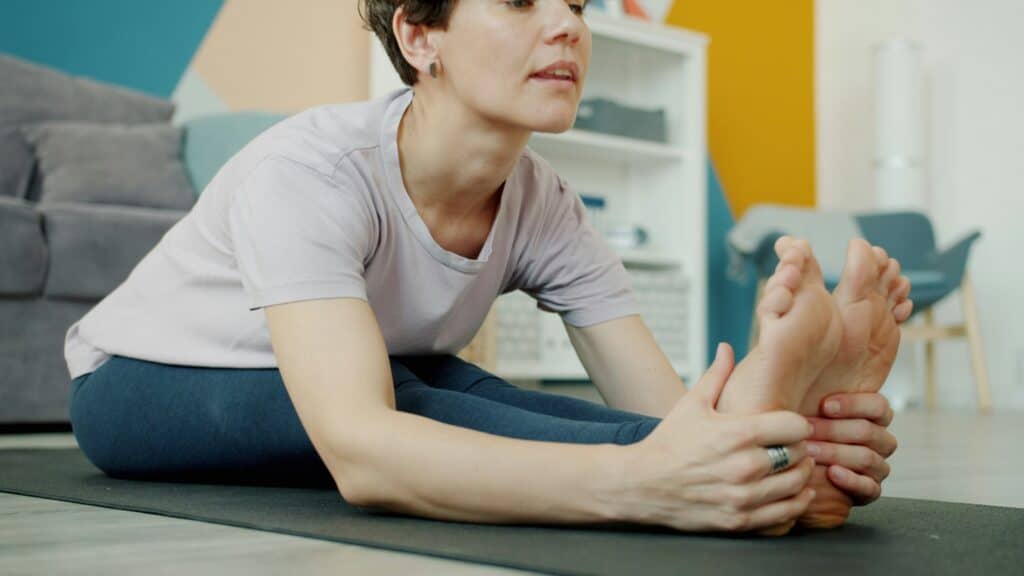
Deep folds, backbends and long holds don’t feel safe for me now.
Instead, I’m being pulled back to what first drew me to yoga: stillness and breathwork.
Signs of hypermobility in women that are easy to miss
You may not have HSD. Only a clinician can tell you that.
But if several of these sound familiar, it may be worth asking your GP about hypermobility:
-
- Widespread joint and muscle pain that moves around your body
-
- Fatigue that rest doesn’t fix, or needing days to recover from exercise
-
- Being very flexible, now or when you were younger
-
- Joints that click, feel unstable, or give way
-
- Local anaesthetic that doesn’t seem to work
-
- Painful smear tests or pelvic pain
-
- Dizziness when you stand up, or palpitations
-
- Raynaud’s or feeling the cold badly
-
- Symptoms that got noticeably worse around perimenopause or menopause
-
- ADHD, autism, or other neurodivergence, in you or your family
-
- Feeling that exercise or stretching doesn’t go the way it seems to for others
-
- Being told for years that it’s “just normal”
When you speak to your GP, it can help to write down all your symptoms in one list, even the ones that seem unrelated. That’s often how the pattern gets spotted.
What happens next for me
I’ve been referred to a physiotherapist who understands hypermobility, and I’m keen to start with physical approaches first.
I’m learning to stop pushing through, and to treat my body with the same compassion I’d offer any of my clients.
If you can relate to any of this
You’re not being dramatic, and you’re not failing at things other women seem to manage.
Sometimes there’s a reason. It just takes a long time to find it.
I’m still processing all of this, and I’ll keep sharing what I learn.
Thank you to Dr Gurdeep Dulay, who listened to the whole story and finally joined the dots.
Frequently asked questions
Can hypermobility cause widespread pain and fatigue?
Yes. Widespread joint and muscle pain and fatigue are among the most common symptoms of Hypermobility Spectrum Disorder and hypermobile Ehlers-Danlos syndrome. Muscles work harder to stabilise loose joints, sleep is often disrupted by pain, and the nervous system can be affected too.
Does hypermobility get worse after menopause?
Many women find their symptoms get worse during perimenopause and after menopause. Falling oestrogen affects connective tissue, and hormonal changes can amplify hypermobility symptoms. Some women find HRT helps, but research in this area is still limited, so it’s worth discussing with your doctor.
Is hypermobility linked to ADHD?
Research suggests it is. Studies have found that neurodivergent people, including those with ADHD and autism, are more than twice as likely to be hypermobile as the general population.
How is HSD diagnosed?
HSD is usually diagnosed by a GP, rheumatologist or other specialist. They’ll look at how far your joints move (often using the Beighton score), your symptoms, your medical history and your family history. They may also run tests to rule out other conditions.
Can you be diagnosed with hypermobility later in life?
Yes. Many women are diagnosed in midlife, often after menopause brings symptoms to the surface. Joints tend to stiffen with age, so it can help to tell your doctor if you were very flexible when you were younger.
Further reading and resources
If you’d like to learn more, these are a good place to start:
Support organisations
-
- Hypermobility Syndromes Association (HSA): www.hypermobility.org
-
- HSA: Hormones and hypermobility: hypermobility.org/hormones-and-hypermobility
-
- HSA: Local anaesthetic and hypermobility: hypermobility.org/local-anaesthetic
-
- Ehlers-Danlos Support UK: www.ehlers-danlos.org
-
- NHS: Joint hypermobility: nhs.uk/conditions/joint-hypermobility
Research
-
- Csecs JLL, Iodice V, Rae CL, et al. (2022). Joint hypermobility links neurodivergence to dysautonomia and pain. Frontiers in Psychiatry, 12:786916. https://www.frontiersin.org/journals/psychiatry/articles/10.3389/fpsyt.2021.786916/full
-
- University of Sussex (2022). Neurodivergent people more likely to experience pain, due to hypermobility. Plain-English summary of the study above. https://www.sussex.ac.uk/broadcast/read/57237
-
- Glans M, Thelin N, Humble MB, Elwin M, Bejerot S (2021). Association between adult attention-deficit hyperactivity disorder and generalised joint hypermobility: a cross-sectional case control comparison. Journal of Psychiatric Research, 143:334-340. https://pubmed.ncbi.nlm.nih.gov/34560594/
-
- Hakim AJ, Grahame R, Norris P, Hopper C (2005). Local anaesthetic failure in joint hypermobility syndrome. Journal of the Royal Society of Medicine, 98(2):84-85. https://pmc.ncbi.nlm.nih.gov/articles/PMC1079398/
-
- Gilliam E, Hoffman JD, Yeh G (2020). Urogenital and pelvic complications in the Ehlers-Danlos syndromes and associated hypermobility spectrum disorders: a scoping review. Clinical Genetics, 97(1):168-178. https://pmc.ncbi.nlm.nih.gov/articles/PMC6917879/
-
- Castori M, Tinkle B, Levy H, et al. (2017). A framework for the classification of joint hypermobility and related conditions. American Journal of Medical Genetics Part C, 175(1):148-157. Non-specialist summary from The Ehlers-Danlos Society: https://www.ehlers-danlos.com/2017-eds-classification-non-experts/framework-classification-joint-hypermobility-related-conditions/
This post shares my personal experience and is not medical advice. If you’re worried about any of your symptoms, please speak to your GP or a healthcare professional.