
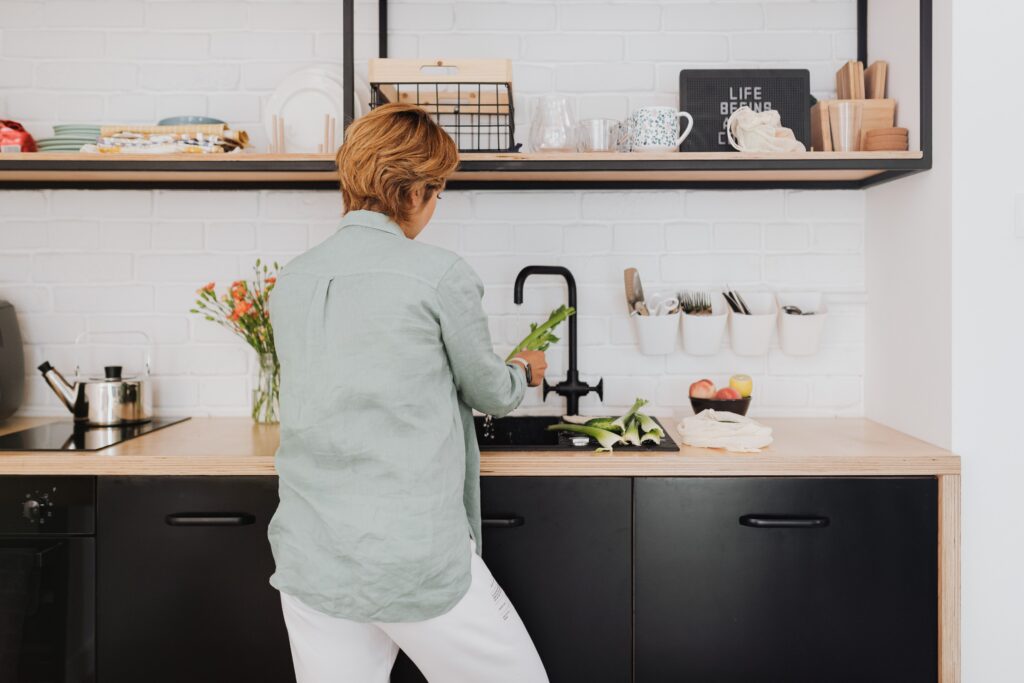
There was a time when I believed that a “good” mum cooked the evening meal every night. I don’t remember anybody ever actually saying that to me, but somewhere along the way I’d absorbed the message all the same. A proper meal. Home cooked. Served at the table. The family sitting together, talking about their day before everyone disappeared off to do their own thing.
It was such an ordinary picture that I never really questioned it. It was simply what families were supposed to do. So I tried. Goodness knows I tried. The reality, however, looked rather different.
Long before I ever discovered that all three of my children were neurodivergent, I knew that family mealtimes were anything but relaxing. Everyone had different likes and dislikes. Different sensory preferences, routines, appetites, and ideas about what constituted an acceptable meal. Trying to persuade everyone to sit down together at the same time often created more tension than connection and, on occasions, it ended in frustration, resentment or full-blown meltdowns.
For years I thought I simply wasn’t trying hard enough. Eventually, though, I stopped trying to recreate the family meal I’d grown up believing we were supposed to have and started paying attention to the family I actually had.
Looking back now, I realise that was probably one of the first times I consciously adapted our home to meet neurodivergent needs, even though I didn’t have that language at the time. I thought I was adapting to my children. What I didn’t yet understand was that I was also adapting to myself.
The pressure eased almost immediately. Instead of insisting that everybody sit around the table together, we found a rhythm that suited us. People ate at different times, and ate different foods. They ate where they felt comfortable. It probably didn’t look much like the family dinners I’d imagined when I first became a mum, but there was considerably less stress and a great deal more peace.
What we lost in routine, we gained in peace. We stopped trying to look like the family I thought we should be and started functioning more like the family we actually were.
For a while, that was enough. Then life changed again. Menopause arrived.
Along with it came a level of exhaustion I had never experienced before. Decisions became harder. Motivation became harder. Even relatively simple tasks sometimes felt disproportionately difficult, and cooking dinner every evening gradually shifted from something I felt I should do to something I simply didn’t have the energy to face.
At first, I felt guilty. More than guilty, if I’m honest. I felt like I was failing. Not because my family were going hungry (they weren’t) but because I had quietly equated cooking with being a good wife and a good mum. If I wasn’t putting a meal on the table every evening, had I somehow stopped looking after my family properly? It has taken me years to realise that those are two entirely different questions.
For a long time, I assumed I was simply running out of energy. And, to a certain extent, I was. Menopause had changed me in ways I wasn’t expecting, and preparing an evening meal at the end of the day often felt like one demand too many. It wasn’t just the cooking itself that I struggled with; it was deciding what to cook, checking whether I had the ingredients, trying to follow a recipe without missing a step, remembering what everyone did and didn’t like and somehow producing something that suited everyone.
Looking back, I’m not entirely sure why I kept thinking the answer was to try harder. Perhaps because I’d spent a lifetime believing that was what good women did. Good wives. Good mums. They kept everyone fed. It wasn’t until much later that I realised I’d quietly stopped questioning whether those expectations made sense for our family. Instead, I’d simply measured myself against them.
Then, earlier this week, I came across a wonderful summary of some newly published research exploring food preparation in adults with ADHD. As I read through it, I found myself nodding over and over again because the researchers described something I’d never quite found the words for myself. They suggested that many adults with ADHD don’t necessarily struggle because they lack cooking skills. Instead, the difficulty often lies in managing the executive functioning demands that surround the whole process of feeding ourselves.
That distinction stopped me in my tracks. Because when we talk about preparing food, we tend to picture the moment we’re standing in the kitchen, chopping vegetables or stirring a saucepan. In reality, preparing a meal often begins hours earlier. Deciding what to eat, checking what’s already in the cupboards, writing a shopping list, remembering to take it to the supermarket, navigating the sensory overload of shopping, bringing everything home, putting it away, remembering what you’ve bought, finding the motivation to begin, following the recipe, adjusting when something doesn’t go to plan and then clearing everything away afterwards before waking up the next day and doing it all over again.
Suddenly, I wasn’t looking at one task anymore. I was looking at twenty. And perhaps that’s why so many of us feel overwhelmed before we’ve even turned the oven on.
Reading the research also helped me understand something else. It wasn’t that I’d stopped caring about my family – far from it. I’d simply reached the point where I could no longer carry responsibility for everybody else’s meals as well as my own. They’re very different things.
These days, there are four adults living in our house, and we’re each responsible for feeding ourselves. That doesn’t mean we never eat together and it certainly doesn’t mean I’ve stopped caring whether everyone has eaten well. I still do. I suspect I always will.
What has changed is that I’ve stopped believing it’s my responsibility to carry that mental load for everybody else. One of the things I talk about regularly with my coaching clients is the difference between capability and capacity. They’re often confused, but they’re not the same thing at all.
Capability is about whether we can do something. Capacity is about whether we have the physical, emotional and cognitive resources available to do it today. It’s an important distinction because so many women I work with judge themselves by their capability whilst completely overlooking their capacity.
They’ll tell me, “But I know I can do it.” And they’re right. They probably can. The real question isn’t whether they can. It’s whether they have enough available executive functioning, enough emotional bandwidth and enough energy to do it on that particular day, alongside everything else life is asking of them.
For years, I failed to make that distinction in my own life. I knew I was capable of cooking. I understood the basics of nutrition, I could follow a recipe (most of the time!), and I’d successfully cooked for my family for years. So, when I found myself increasingly avoiding it, I assumed I was becoming lazy, disorganised or simply not trying hard enough.
Looking back now, I can see how unfair that was. I hadn’t lost my capability. I’d lost my capacity. Or, perhaps more accurately, my capacity had changed.
Between navigating perimenopause and menopause, unknowingly living with ADHD and autism, supporting three neurodivergent children into adulthood and trying to keep all the plates spinning, my nervous system was already carrying an enormous load. By the time evening arrived, there simply wasn’t enough left in the tank to plan, organise, prepare and cook a meal from scratch every single day.
The research validated something I think many of us intuitively know but struggle to explain. Preparing food isn’t a single task; it’s a collection of executive functioning demands stacked one on top of another.
When we only look at the finished outcome – “Can she cook a meal?” – we miss everything that came before it. And that’s where shame so often creeps in. We compare ourselves to an idealised version of ourselves, or perhaps to an imaginary version of womanhood we’ve inherited from somewhere, without ever stopping to ask whether the expectations we’re holding ourselves to are realistic in the first place.
For me, the answer wasn’t to push harder. It was to adapt. To stop believing there was only one “right” way to care for my family. Stop measuring my worth by whether there was a home-cooked meal on the table every evening. And recognise that meeting our needs was far more important than meeting an expectation.
Years ago, I might have apologised for eating something as simple as beans on toast. These days, I don’t. I’ve stopped measuring my meals against an imaginary standard of what dinner is supposed to look like. Some days, simple is exactly what my capacity allows – and I’ve learnt that simple doesn’t mean I’ve failed.
One unexpected gift of reading this research wasn’t simply recognising myself in the findings. It was realising just how much shame I’d attached to something that was never really about cooking in the first place.
For years, I’d measured myself against an expectation I’d never stopped to question. Somewhere along the line, I’d decided that feeding my family had to look a particular way. A home-cooked meal. Around the table. Every evening. Because that was the picture I’d inherited of what being a “good” wife and mum looked like.
Now, I wonder how many of us are carrying expectations we’ve never consciously chosen. As women, we’re often praised for holding everything together, anticipating everybody else’s needs and quietly carrying the mental load. It’s hardly surprising that so many of us struggle to notice the moment our capacity has been exceeded because we’ve been taught that asking less of ourselves somehow means caring less for the people around us.
I don’t believe that anymore. If anything, I’ve learnt that the opposite is true. When we stop measuring ourselves against somebody else’s definition of what a “good” wife, mother or homemaker looks like, we create space to ask a much more helpful question.
What actually works for us?
Not for the family in the television advert, the family next door or the family we imagined we’d one day become. But for the people who actually live under our roof. For us, the answer won’t look the same as it does for somebody else. And that’s exactly as it should be.
The more I reflect on my own journey, the more I realise that adapting wasn’t a sign that I’d failed. It was a sign that I was paying attention. Attention to the needs of my family, certainly, but also to my own changing capacity. Looking back now, I can see that I’d spent years trying to fit my family into a picture that had never really belonged to us, instead of trusting that we were allowed to create one of our own.
Perhaps that’s what this research has really reinforced for me. Not that I needed to become better at cooking, but that I needed to become kinder to myself. Because the goal was never to prepare the perfect meal, prove that I could keep all the plates spinning or perform somebody else’s version of motherhood.
The goal was always to nourish the people I love … and that includes me.